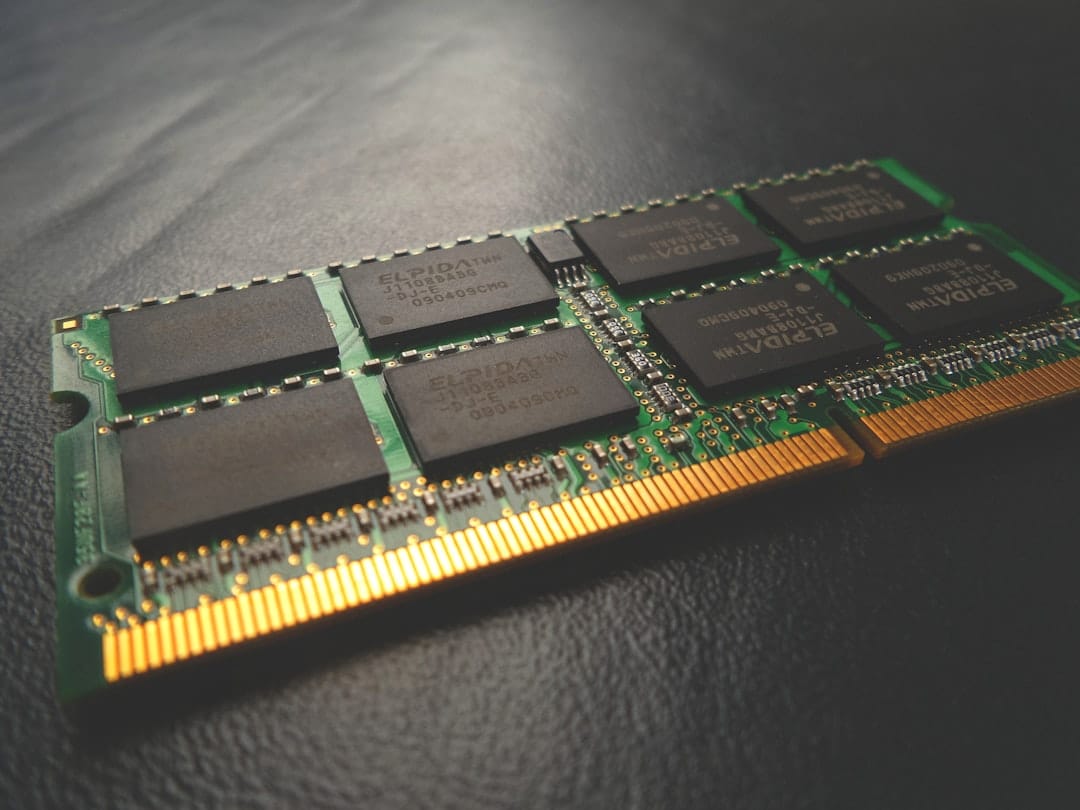
Server DRAM just got its next bandwidth step. Renesas announced its Gen 3 MRDIMM chipset on July 30, pushing module speeds to 16,000 MT/s — 25% above the Gen 2 generation that shipped in Xeon 6 and EPYC Turin platforms.
For anyone running large models on CPU or mixed CPU/GPU pathways, this is the number that matters. LLM decode is memory-bandwidth-bound. In single-stream inference you don't gain tokens from faster compute — you gain them from moving weights faster from DRAM to the compute unit. A 25% bandwidth jump translates roughly into more decode throughput for a fully loaded system. That's the difference between a workable agent loop and a sluggish one.
Why MRDIMMs exist: standard RDIMM tops out at 6,400 MT/s. MRDIMM doubles that by buffering data in the module and letting two ranks run interleaved — effectively acting like a wider interface. Gen 1 hit 8,800 MT/s, Gen 2 hit 12,800 MT/s. Renesas' Gen 3 brings the controller to 16,000 MT/s. The DRAM die itself is unchanged — these are still DDR5-6400-class chips. The intelligence lives in the MRDIMM buffer controller, not the memory cell.
| Generation | Speed (MT/s) | Bandwidth vs RDIMM |
|---|---|---|
| DDR5 RDIMM | 6,400 | baseline |
| MRDIMM Gen 1 | 8,800 | 1.38× |
| MRDIMM Gen 2 | 12,800 | 2.0× |
| MRDIMM Gen 3 (new) | 16,000 | 2.5× |
The practical piece for homelab: Renesas designed Gen 3 to run on existing DDR5 server motherboards. You are not swapping the board for a new speed tier — the chipset is drop-in compatible where the platform's BIOS and memory controller support it. That is rare for a platform memory advance. Normally a new speed class means a new board and often a new CPU. Here the existing memory controller stays in play, assuming Intel and AMD enable the higher rate via microcode on their current server platforms.
Where this genuinely changes things:
- CPU inference servers (llama.cpp across many cores) get the biggest real gain. Decode tok/s scales with bandwidth.
- vLLM or TGI serving on CPU, or hybrid GPU+CPU offload, gets proportional headroom.
- Agent workloads hammering the KV cache in system RAM see the latency cut directly.
Tradeoffs you should weigh:
- MRDIMMs carry a premium over RDIMM — and the market is tight. Server memory already spiked roughly 70% this year, and DDR5 pricing tripled since October. This is a spec to plan around, not to buy into at peak.
- 16,000 MT/s is still far below HBM. A single A100's HBM2e delivers about 2 TB/s across a few hundred GB. MRDIMM fixes CPU-side bottlenecks; it does not replace a GPU.
- Adoption depends on Intel and AMD validating Gen 3 in currently available server platforms. Renesas supplies the controller; you need a board and a CPU that actually run 16,000 MT/s.
Verification: I would want to see Gen 3 modules on a Turin or Granite Rapids board running llama.cpp before trusting the vendor's 25% figure. The spec is concrete and reproducible; the measured throughput should follow within a benchmark cycle. Renesas' compatibility claim is the part I would test first, since it is the unusual one.
My take: for a flagship server build later this year or next, this is the memory generation to wait for. For a homelab today, the price environment makes this a planning note rather than a purchase trigger. If server DRAM ever normalizes this cycle, Gen 3 MRDIMM is where the bandwidth per dollar lands.
Sources: