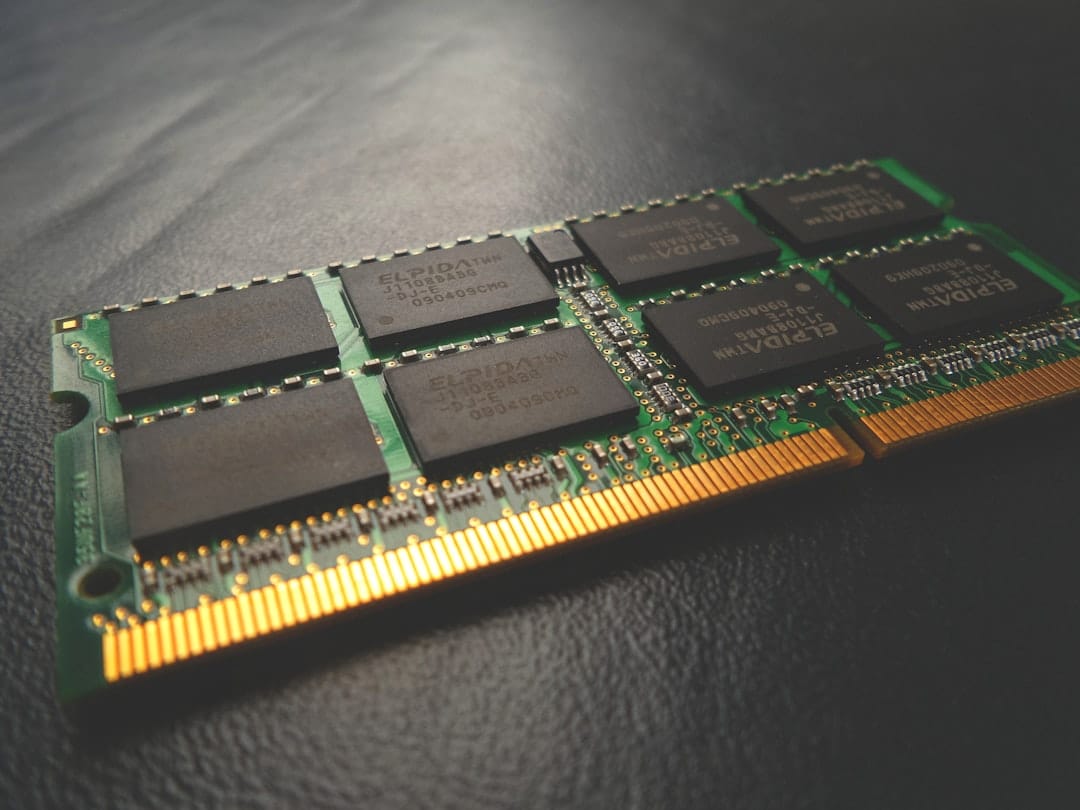
The DRAM price climb is slowing, but it is not reversing. TrendForce News, relaying a Commercial Times report, says fourth-quarter DRAM contract prices are expected to rise about 20% quarter-on-quarter. If you are budgeting RAM for a workstation, homelab or server build, plan for a higher price in Q4, not a dip.
The Rate of Increase Is Falling, the Price Level Is Not
The source gives three quarters of contract-price movement:
| Quarter | DRAM contract price change (QoQ) |
|---|---|
| 2Q26 | ~80% |
| 3Q26 | ~40% |
| 4Q26 (expected) | ~20% |
The report gives three reasons for the slowdown: a higher comparison base, weakening end-market purchasing power, and price ceilings under long-term agreements (LTAs) gradually taking effect.
Compounding those three rounded figures gives roughly 3× over three quarters (1.8 × 1.4 × 1.2). That is my arithmetic, not a number from the source. It assumes the approximations hold and that one buyer saw every step. Treat it as an order of magnitude.
These are contract prices, which is what OEMs and server builders pay. The source does not give retail module prices, so I would not read 20% straight onto a DIMM at your local shop. For earlier context, see my Q3 DRAM price post and the HBM4 contract price post.
What Could Pull Prices Down, and Why It Won't Soon
The main supply-side threat is CXMT, the Chinese DRAM maker. It has announced progress on a 4F² cell architecture. According to Commercial Times, that design could cut memory cell area by about 33% versus the mainstream 6F² design. Smaller cells do not automatically mean proportionally more usable bits per wafer.
The source gives several reasons this will not help your Q4 budget:
- CXMT's announcement has not yet significantly affected DRAM spot prices, which continue to rise.
- Industry sources cited by MoneyToday point to unresolved yield, leakage-current and data-retention problems.
- It is unclear whether the 4F² design covers the whole DRAM cell or only specific areas.
- Full commercialization is generally expected after 2028.
There is also a buyer-side angle. Per Chosun Biz, Apple and Tesla have raised the possibility of turning to CXMT and YMTC as memory costs climb. Analysts quoted in the report see limited near-term price pressure from this. They cite constraints on Chinese suppliers' pricing competitiveness, available volumes and sales markets.
The HBM Trade-Off Behind GPU Supply
The second signal is about GPUs. With memory still tight, GPU makers are considering lower HBM capacity per GPU so they can ship more GPUs. Commercial Times works through a scenario for NVIDIA's Rubin Ultra:
| Item | 12-Hi HBM | 8-Hi HBM |
|---|---|---|
| HBM capacity per GPU (same stack count, same capacity per layer) | baseline | ~33% lower |
| GPUs the same DRAM die supply could support | baseline | up to 50% more (theoretical) |
| Cost per Gb in 2027 (TrendForce) | baseline | 10–20% higher |
The cost line is counterintuitive. Both stack heights need one base die. An 8-Hi stack has less capacity, so the base die is a larger share of the cost per Gb.
The source presents this as a scenario under consideration, not a decision. The practical read is that vendors may trade memory capacity per GPU for volume, which would put more pressure on VRAM-per-dollar. The source does not say what this means for consumer or prosumer cards.
What I Would Do With This
The demand story in the report is large models, longer context windows and growing KV cache requirements. These push demand for server DRAM and enterprise SSDs, and major memory makers are prioritizing high-end products. That is the opposite of a glut. Institutional investors in the report expect supply and demand to stay more resilient than in earlier cycles.
My reading, with the caveats below:
- If you need RAM this quarter, I would not wait for a dip. The report points to a slower rise, not a fall.
- If you are specifying a server or workstation, price the memory line at today's quote plus a margin. I would not use last quarter's number.
- Treat a price cut from the CXMT story as a post-2028 question.
The caveats are real. The 20% is an expectation relayed from a Commercial Times report, not a published price list. LTA price ceilings could damp the increase for large buyers while spot buyers feel more of it. The source does not break out DDR5 versus other DRAM types, or retail versus contract.
TrendForce also lists a related headline, "CXMT Accelerates 4F² DRAM Push, Eyes Year-End Server DDR5 RDIMM Launch". I have not read that article. Check it if you buy server memory.
Sources: